
DVT (Deep Vein Thrombosis)
A DVT is a blood clot that most commonly occurs in the leg, typically only one leg (image 1). However, occasionally it occurs in both legs at the same time (=bilateral DVT). Sometimes, a DVT is in the pelvic veins or the big abdominal vein (=inferior vena cava). And some DVTs occur in the arm. The anatomy and terminology of leg, pelvic and arm veins (together called “venous clot” or “venous thromboembolism=VTE) is also discussed here.

Symptoms range from no symptoms whatsoever, to barely noticeable, to severe. Symptoms may be in the foot, ankle and calf, or involve the whole leg. Similarly, in the case of arm DVT, the symptoms may involve only the forearm, or also include the upper arm. They occur not just for a few seconds or minutes, but for hours or days. The classic symptoms of an acute DVT are:
- Pain
- Swelling
- Discoloration (bluish, slightly purplish or reddish)
- Patients may also have lower back pain, if the clot is in the veins in the pelvic area or abdominal vein (= inferior vena cava = IVC).
Superficial clot (superficial thrombophlebitis) and postthrombotic syndrome
Not typical for DVT is when a patient has tenderness, pain, swelling, redness, or warmth in just one clearly defined, focal area, when the skin is exquisitely tender and the pain feels like it is right in the skin, or when the patient is able to feel a clot or a firm cord. Those symptoms suggest a superficial clot (=superficial thrombophlebitis). The symptoms of a chronic/old DVT – a condition also called “postthrombotic syndrome” – will be explained in a separate blog entry.
PE (Pulmonary Embolism)
A PE is a blood clot in the blood vessels in the lung (images 1-3). The terminology can be confusing and misleading: Arteries are defined as blood vessels that lead away from the heart, veins as vessels that lead blood back to the heart. DVTs occur in veins. Because of the way that the lung is anatomically built into our circulatory system, the vessels leading from the heart into the lung are called arteries, even though the structure of these vessels is much more like that of veins. In addition, clots breaking off from DVTs in the veins of the legs, pelvis or arms, travel in the blood stream towards the heart, through the right heart chamber and then into the lung arteries (=pulmonary arteries), where they get lodged. So even though these clots are in the vessels called pulmonary arteries, they are really considered vein clots. DVT and PE are refered to as venous thromboembolism (VTE), reflecting, that both are really vein clots.
Symptoms of PE also range from no symptoms whatsoever, to barely noticeable, to severe, depnding on how big the clot is (images 2,3). In the most severe case, a massive PE can lead to instant death. Very small PEs fairly commonly occur in patients with DVT and lead to no symptoms whatsoever. The classic symptoms of an acute PE are listed below. They occur not just for a few seconds or minutes, but for hours or days.
- Chest pain, particularly when taking a deep breath in
- Shortness of breath
- Unexplained cough (sometimes coughing up of blood)
- Unexplained heart racing or pounding
- Passing out / loosing consciousness
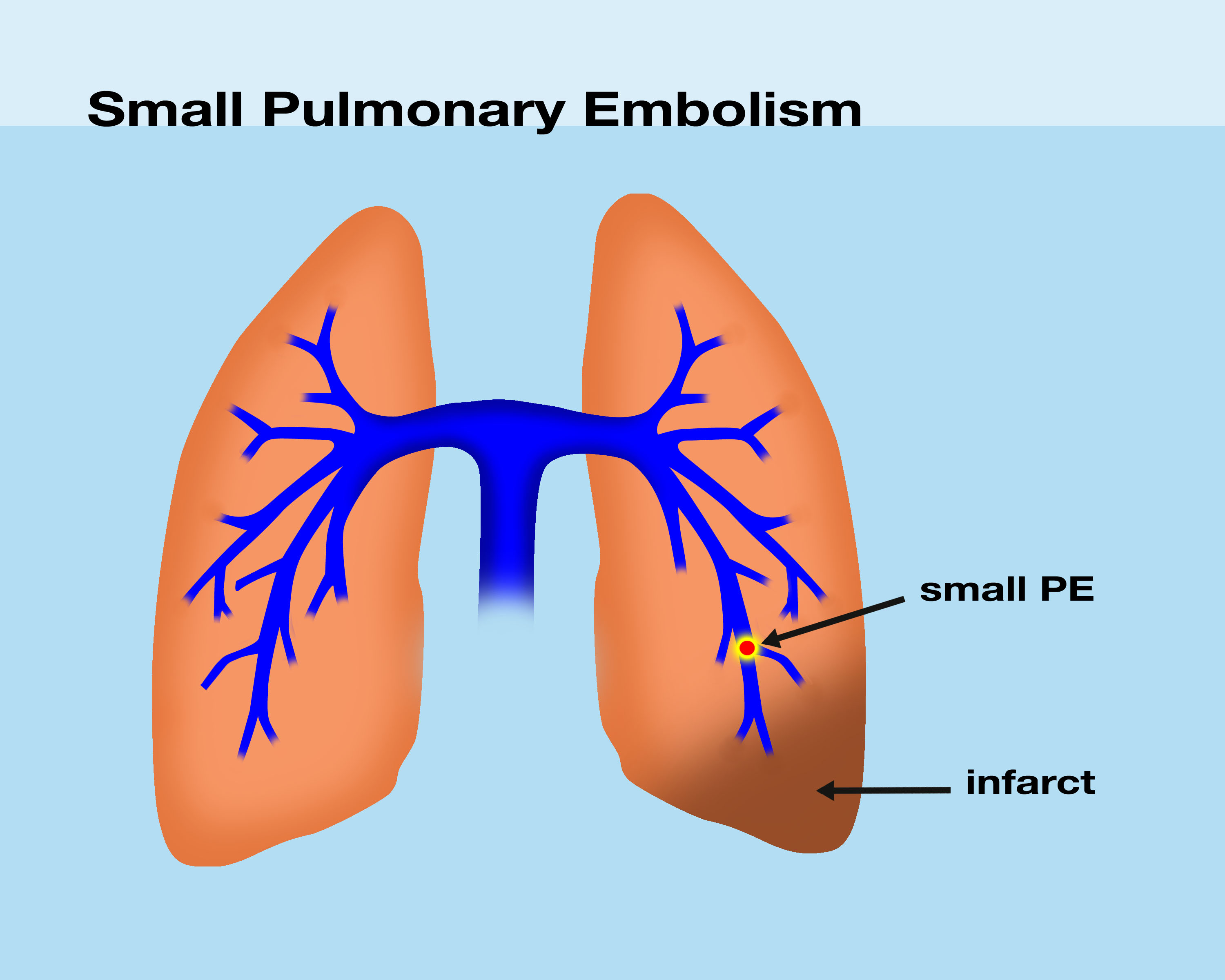
Risk factors for DVT and PE:
Immobility
- Hospitalization
- Stroke resulting in bedridden state or chronic wheelchair use
- Prolonged sitting
Surgery and Trauma
- Major surgery (pelvis abdomen, hip, knee)
- Bone fracture or case
- Catheter in big vein
Increased Estrogens
- Birth control pill, patch or ring
- Pregnancy, for up to 6 weeks after giving birth
- Hormone therapy
Medical Conditions
- Cancer and its treatment
- Heart failure
Other Risk Factors
- Previous blood clot
- Family history of clots
- Clotting disorders
- Obesity
- Smoking
Patient Questions/Comments/Examples – Explanations
Question #1: “When I had my DVT, it pretty well hit me all at once. I remember having a little bit of backache the weekend before, but I had passed it off as coming from the road trip I had done earlier. When I was walking to work my leg suddenly stiffened up and hurt bad. It was also very swollen. By the time I was admitted to the hospital it was starting to change color.”
Answer #1: This patient presented with the classic symptoms of DVT: (a) leg pain, (b) leg swelling, (c) leg discoloration. Patients may also have lower back pain if the clot is in the veins in the pelvic area or abdominal vein (= inferior vena cava = IVC). It sounds as if a prolonged road trip may have been the triggering factor in this patient.
Question #2: “I had what I thought was a pulled muscle in my left calf for about three weeks. I play golf about 4 times per week and usually walk and carry my bag. I figured this was why it wasn’t getting better. While golfing one day I felt like my heart skipped a beat; then I became very weak and didn’t have the energy to carry my bag. I felt no pain and could take a full breath, but knew I wasn’t getting enough oxygen to my lungs. It was 2 days later that my calf started swelling and I went to my doctor. I was found to have a DVT and a PE.”
Answer #2: This patient also presents in a classical manner: unspecific leg symptoms, such as muscle cramp, leg tightness, leg heaviness, but initially no discernible swelling. The suspicion that this may be a DVT would be increased if the patient had risk factors for DVT and PE. The above patient then develops symptoms of PE: he/she has air-hunger (in medical terms: dyspnea. And then develops leg swelling. Some patients develop significant symptoms within a few hours or a day; in others symptoms develop slowly and creep up over several days or sometimes even a few weeks.
Question #3: “How much pain does a DVT give? My DVT 3 years ago gave pain that was at the screaming level. Are they always like that? The pain level this time is much less; does that mean it is NOT a DVT? It’s more like a cramp.”
Answer #3: Some patients have a lot of pain from an acute DVT, others have none. Some have a lot of swelling, others none; some have diffuse warmth and bluish/purplish discoloration, others none. It is often difficult and not infrequently impossible to tell whether leg symptoms are a DVT or something that is not serious, such as a Charley horse. Presence of the risk factors mentioned above increase the suspicion that the subtle symptoms may, indeed, be due to a DVT or PE.
Question #4: “My biggest frustration is discerning when symptoms should be addressed or ignored.”
Answer #4: This is, indeed, one of the biggest difficulties and frustrations for patients as well as physicians: to know which leg symptoms are “just” due to the previous clot (in the person who has had a clot before) and the post-thrombotic syndrome, and which symptoms may be due to a new clot; or which chest symptoms are “just” due to the previous PE, and which symptoms should be taken more serious and should alert patient and physician for an acute new clot and lead to imaging studies to be done.
Question #5: “When I had my DVT following foot surgery, my entire left leg became swollen. I had never had a blood clot before, so I did not recognize it; I just thought it was just sore and swollen from the surgery. 3 weeks post-op I put on a pair of comfortable pants and they would not fit over my calf. The swelling was much more noticeable than the pain. However, I was on pain meds and may be that’s why I did not notice the pain. An ultrasound in the ER showed a clot in the upper thigh.”
Answer #5: This is a classic presentation – diffuse pain and swelling of one leg within 1 week of surgery. In this patient one should have a high suspicion for DVT in view of the risk factor of recent surgery. The patient should have received education about the risk of DVT after surgery and the signs to watch out for. The DVT should have been diagnosed earlier. She should have had a physical examination and a Doppler ultrasound immediately when the swelling started.
Question #6: “Is it possible that I have had a DVT in the past without knowing it?”
Answer #6: Yes. A fair number of DVTs, particularly the postoperative ones, go unnoticed, because they are too small (usually in the calf = distal DVT) to cause any symptoms.
Question #7: “I had shortness of breath and they treated me for asthma with an inhaler, which didn’t seem to help. I had smallish chest pains off and on, attributed to my fibromyalgia. No one thought to check out my lungs until the third time I presented at the ER short of breath. I was diagnosed by a lung perfusion scan with a shower of pulmonary embolisms; probably had been throwing small clots for years.”
Answer #7: If an adult patient presents with shortness of breath, but has never had asthma as a young person, then a diagnosis of “adult-onset asthma” is unlikely. PE should be considered.
Question #8: “When I had a PE in my right lung, the pain when I was lying down was like a pulled muscle or something similar. Then, when I sat up, it felt like the right lung had just shut off. I couldn’t breathe on that side. Afterwards, in the hospital, it was painful to take a deep breath.”
Answer #8: Pain, worse on inspiration, plus shortness of breath – could be a PE, but could also be pneumonia with pleurisy. A physician would want to know whether the patient has risk factors for PE, may want to obtain a D-dimer test, and consider an imaging study to assess for PE (such as VQ scan = ventilation/perfusion scan, or CT scan of the lung, called CTA).
Quetion #9: “A year ago I was feeling like I was having a heart attack, short of breath, no energy, had to sit up to try to sleep, couldn’t lay down because I felt I was smothering. When I went to the bathroom and stood up, that’s the last I remember except my children screaming and crying and yelling my name. I felt very at peace and knew this was the end. But they revived me and I was diagnosed with passing a blood clot to the lung. I never felt anything in my legs, but they said I had a clot in my right leg.”
Answer #9: This patient had, judged by symptoms of passing out, a big PE. A slightly bigger one or the lack of presence of family could have led to this patient’s death from PE. In most patients with PE a DVT is also found. However, in about 25 % of patients with PE, no DVT is found. This may be due to (a) clot in the leg veins that was initially present, but has completely broken off and traveled to the lung, (b) the PE having come from the veins in the pelvis or the big abdominal vein (inferior vena cava), which can not be seen on Doppler ultrasound, (c) the clot having formed in the lungs, or (d) the clot having from a DVT in the arms.
Disclosure: I have no financial disclosure relevant to this blog entry.
Last updated: Feb 12th, 2011

 Clot Connect
13 responses to “Symptoms of DVT and PE”
[…] Symptoms of a blood clot include: […]
I had a blood clot under right knee 30 years ago – have worn compression hose – last time had pneumonia and p/e was off 4 months. Recently I became very weak – and collapsed – did not pass out – went to hospital and put on heparin – although my urge to get back into doing things – re: bank – getting hair done -I found my self either tired or anxious on my first time out – – I have used up my sick leave – Dr wants me to retire – he said stress was my worse enemy – I have been off work since February 10th – wish I knew if I will get over that weak feeling – or am I pushing myself??
Weakness and fatigue after a DVT or PE are common. There are a number of reasons. Certainly, a DVT or PE can be a life-changing event. The body needs time to heal. Typically things improve. However, some people will have chronic leg symptoms – https://clotconnect.wordpress.com/2011/07/21/dvt-long-term-damage-post-thrombotic-syndrome/ – , others chronic lung damage – https://clotconnect.wordpress.com/2011/06/29/chronic-lung-damage-after-pe-%E2%80%93-pulmonary-hypertension-cteph. Both can lead to chronic fatigue. And warfarin itself as a drug can cause fatigue as a side effect. Or warfarin can cause to chronic bleeding and anemia (low blood counts), such as from heavy menstrual bleeds or blood loss from the gastrointestinal tract. Full medical evaluation is needed to determine what might be the cause of the weakness and fatigue and to address it appropriately.
ive been getting lower calf pain had a dopler scan done but they just scanned the upper part of my leg above the knee and not my calf were the pain is why
It would be appropriate to do a lower leg Doppler ultrasound to look for calf vein DVT, not just a study limited to the thigh.
I have had a DVT and PE and I also have a slipped L5. I occasionally have swelling and pain in the leg that had the DVT and I worry whether it is another clot or just pain from PTS or the slipped disc.
Is there anything I can do to help myself determine the difference? Or should I just go the ER when I’m worried? (Additional info – I am no longer on blood thinner, I was for 6 months after and have been off for 5 months)
It can be difficult for the patient (and physician) to determine whether leg pain or swelling is due to a flare-up of postthrombotic syndrome or a new DVT. When in doubt, a Doppler ultrasound should be done. Eventually, many patients get a feel for what symptoms are “just” the fluctuations of postthrombotic syndrome and which ones are new, different, and worrisome enough that they should lead to a physician or ED visit to get a Doppler ultrasound. Similar insecurity is, by the way, experienced by patients with previous PE: which chest pain symptoms are “just” the unspecific symptoms that can be seen after a PE (which we as physicians often contribute as being due to “scar tissue”), and which symptoms should make a patient concerned about a new PE. My advice: when in doubt, see an MD and get a CT or VQ scan. As with leg symtpoms, eventually many patients learn what symptoms are worrisome enough that the patient needs to be checked out for a PE. I rather get one Doppler ultrasound of the leg and one CT of the chest too many, than miss a recurrent clot by having done one scan to few.
Hi I was just diagnosed with Actue Deep Venous Thrombosis involving the left popliteal vein. To complicate matters I’m throwing several PVCs every hour. This was initially why I went to a cardio specialist. Feeling weak, chest heaviness, occassionally short of breath. My doctor started warfarin therapy but has not hospitalized me (initial treatment). I was told because I was not showing signs of PE. Okay I’m just confused as hell, what do I do? Second opinion?
Can you write down the questions you have and the issues you are confused about? Will be happy to respond to all of them. Please send to our Clot Connect address – http://www.clotconnect.org/about-clot-connect/contact-u – or post here in the blog’s comment field. Also, I suggest you participate in this Wednesday’s (Nov 16th, 3 PM E.T.) “DVT/PE – What Patients need to Know” webinar. Details here: https://www3.gotomeeting.com/register/493295702.
I have been seen for superficial blood clots. I am doing all measures to get better but it is traveling up my leg. Could it turn into a DVT?
Yes, possibly. New, more symptoms could be (a) extension of the superficial clot in the superficial veins, or (b) progression to involve the deep veins and, thus, a DVT. If a patient with superficial thrombophlebitis of the leg is not treated, extension of the superficial clot occurs in 3.4 % of patients (i.e. in about 1 of 30 patients); progression to a DVT occurs in 1.23 % of patients (i.e. in about 1 in 80 patients); and 0.3 % of patients will develop a PE (i.e. 1 in about 300 patients). Reference: Decousus H et al. Fondaparinux for the treatment of superficial-vein thrombosis in the legs; N Engl J Med. 2010 Sep 23;363(13):1222-32.
Two weeks ago I was flat on my back with a herniated disc at L5-S1. The nerve pain went down my left leg/calf. With therapy the back/nerve pain was gone but this last week I have had increased left calf pain making it difficult to walk. Today that pain has improved by half. If it were to be a DVT could the level of discomfort decrease like that and if so could it be resolving on its own?
Immobility 2 weeks ago is certainly a risk factor for DVT. Some DVTs resolve without blood thinner treatment, so, yes, pain could spontaneously improve. However, whenever DVT is suspected based on risk factors and symptoms, one should get a Doppler ultrasound.