
Recently diagnosed with a blood clot and searching for answers to your questions? Begin here.

What do you need to know if you’ve had a blood clot?
1. Information is available
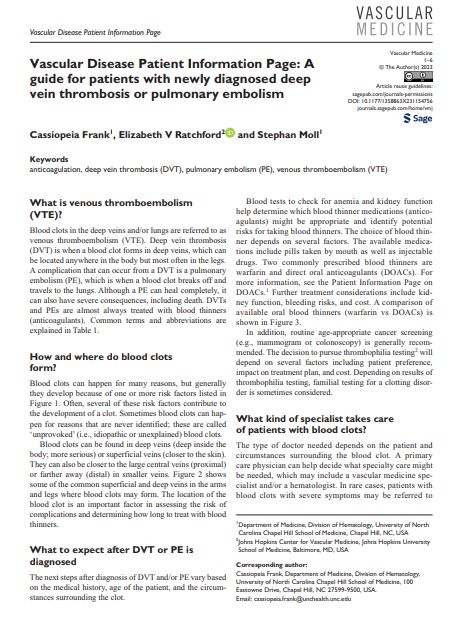
Know there are resources which can help you better understand and manage your condition. You may wish to begin with:
- NEW A Guide for Patients Newly Diagnosed with DVT or PE published in the journal Vascular Medicine available in English and Spanish.
- A comprehensive 28 page educational brochure covering common issues related to diagnosis, treatment and the prevention of complications: “Deep vein thrombosis (DVT) and pulmonary embolism (PE): Information for newly diagnosed patients“.
- You may also wish to review our Frequently Asked Questions page for common concerns and check out our links to Educational Resources.
2. Length of treatment
Know how long you should be treated with a blood thinner. Length of treatment can vary from a few months to long-term over many years and is determined by factors your doctor will discuss with you. If you don’t know your treatment plan, ask: ‘How long should I be on a blood thinner?’. More information about factors influencing length of treatment can be found here.
3. Know about your blood thinning medication.
There are multiple blood thinners, both injectible and oral. A comparison of oral blood thinners is available to help you discuss options with your doctor.
These drugs vary in dosing and other characteristics. Make sure you understand how to take the specific drug you are prescribed. Know:
- Should the drug should be taken with or without food?
- How often should it be taken? (for example, once a day or twice a day)
- Should it be taken at a particular time of day?
- What do I do if I miss a dose?
4. Know how to recognize abnormal bleeding
All blood thinners increase bleeding risk. Know the signs and symptoms of bleeding.
5. Keep follow-up appointments. Review your treatment plan annually.
If you are on a blood thinning medication (anticoagulant) long-term, review with your doctor each year whether continuation is still the right thing to do. Have a dialogue with your doctor which reviews how well you have tolerated therapy and what new published research studies might influence your treatment plan.
6. Compression stockings
Know that compression stockings (when individually fitted) may make your leg feel better. They are beneficial to treat long-term leg pain and swelling that sometimes follows DVT. For more information, read “A guide to compression stockings”
7. Medical care and support
Know what medical center and what doctor to turn to for state-of-the-art medical treatment and advice. There are unfortunately very few in-person local support groups for persons affected by blood clots, but be sure to ask your doctor if any are available in your area. We have complied a list of support resources.
8. Pregnancy
For women of childbearing age who have experienced clots: For most women, it is safe to get pregnant again, but special blood-thinning treatment may be needed during pregnancy. Consult with your doctor about clot prevention during pregnancy.
9. Clinical trials
Consider participating in a clinical research study. Greater participation in clinical trials means faster answers to research questions, which can lead to better diagnosis and treatment options for persons affected by blood clots and clotting disorders. As your clinician about clinical trials available to you. The National Institutes of Health maintains a database of current blood clot clinical trials.
10. Symptoms and risk factors
If you have experienced a blood clot, you are at higher risk for developing a future clot. Know your risk factors and the symptoms of DVT and pulmonary embolism. Be aware that the symptoms of a future clot may not be identical in presentation to what you experienced in the past. If you suspect a clot, don’t delay in seeking medical care.
Deep Vein Thrombosis (DVT):
A clot that typically is in one leg (can also occur in unusual sites, such as veins in the arm, abdomen or around the brain). Symptoms range from mild to severe; may involve the foot, ankle, calf, whole leg or arm. The classic symptoms are:
- Pain
- Swelling
- Discoloration (bluish or reddish)
- Warmth
Pulmonary Embolism (PE):
A blood clot in the lungs. The classic symptoms are:
- Shortness of breath
- Chest pain (may be worse with deep breath)
- Unexplained cough (may cough up blood)
- Unexplained rapid heart rate
Know your risk for clots is increased if you…
- have major surgery or trauma
- are hospitalized
- are overweight
- are immobile
- are on birth control pill, patch or ring
- are on hormone replacement therapy
- are pregnant
- smoke
- have a family history of deep vein thrombosis or pulmonary embolisms
- have an inherited or acquired blood clotting disorder
- have cancer
- have an inflammatory disorder, such as lupus, rheumatoid arthritis, inflammatory bowel disease
 Clot Connect